


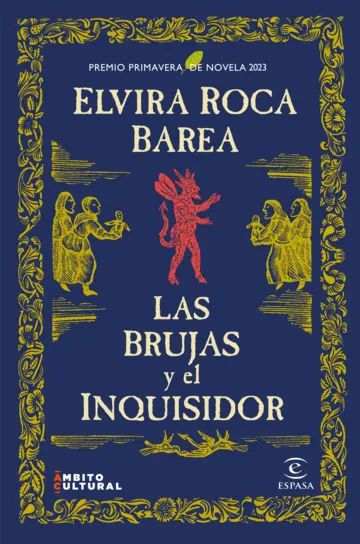

The Witches and the Inquisitor
Publishing date:22 march 2023
Synopsis:
In 1609, several people are accused of witchcraft in the Navarrese village of Zugarramurdi. What seemed like an isolated, insignificant incident begins to take on an unusual virulence. In these circumstances, the Grand Inquisitor Bernardo de Sandoval sends Alonso de Salazar y Frías to Logroño, the seat of the Holy Office.
This is not just about witchcraft, the evil eye, nocturnal flights, or carnal dealings with Lucifer: some confess to atrocious murders and the systematic use of children as acolytes of the Great Horned One. But why this epidemic now, with its epicenter in a village near the French border? Is witchcraft a mirror that reflects various conflicts and interests, many of which have nothing to do with the devil?
In The Witches and the Inquisitor, Elvira Roca unveils the historical figure of Alonso de Salazar, as forgotten as he is relevant, and takes us on a fascinating journey through the intricacies of witchcraft in the 17th century, when religious wars, political conflicts, and other circumstances sparked a massive witch hunt across Europe. In the case of Zugarramurdi, we must also consider the rivalry between France and Spain for control of Navarre. Alonso de Salazar, the inquisitor, will confront all of this with the most powerful of human weapons: reason.
Highlights
Highlights The Witches and the Inquisitor
The gripping novel that breaks with the stereotypes of the Inquisition and witchcraft, by Elvira Roca Barea, with over 200,000 copies sold of her works.
International Editions

Croatia
Technical Data
| Technical data | Publish date: 22 march 2023 ISBN: 978-84-670-6923-5 Pages: 576 Imprint: Espasa |
|---|---|
| Rights sold | Croatia(Verbum) and Slovenia (Druzina). |
| Reviews | «Las brujas y el inquisidor nos muestra cómo la razón y el método consiguieron doblegar al fanatismo y la superchería. O mejor dicho: todos esos motivos ocultos que mueven (o, mejor dicho, promueven) la sinrazón humana», Emilia Landaluce, El Mundo. «Elvira Roca en su novela Las brujas y el inquisidor no busca reescribir la historia de la Inquisición española, aunque sí matiza que ha sido retratada desde los estereotipos», Ander Goyoaga, La Vanguardia. «Una historia que aspira a romper los estereotipos y los mitos que han transmitido durante siglos el folclore y la cultura popular, y que nace con una vocación reivindicativa: restituir el nombre y la labor del denostado Alonso de Salazar y Frías, que de una manera injusta terminó cargando con la responsabilidad de lo que allí había ocurrido cuando, en cambio, actuó como un hombre cabal que no creía en demostraciones de fuerza ni el acto purificador del fuego», Javier Ors, La Razón. |